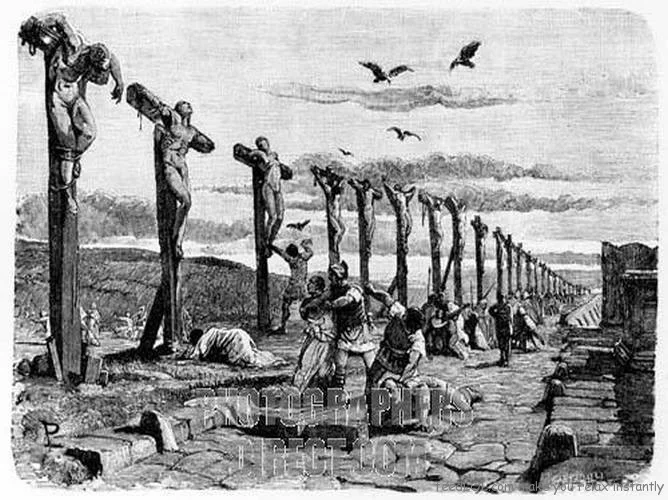
Luke 9:57-62 The Call To Follow Jesus

Here is the basic but epic call to truly follow Jesus. It's a call that eclipses even the call to prophetic office from Elijah to Elisha. It's the most significant enterprise we can fathom, and it's our call.

As they were walking along the road, a man said to him, “I will follow you wherever you go.” Jesus replied, “Foxes have dens and birds have nests, but the Son of Man has no place to lay his head.” He said to another man, “Follow me.” But he replied, “Lord, first let me go and bury my father.” Jesus said to him, “Let the dead bury their own dead, but you go and proclaim the kingdom of God.” Still another said, “I will follow you, Lord; but first let me go back and say goodbye to my family.” Jesus replied, “No one who puts a hand to the plow and looks back is fit for service in the kingdom of God.” (Luke 9:57–62, NIV)

Luke 9:57-62 The Call to Follow Jesus
Edward Anton
Guest UserComment
Luke 9:37-43 Bring the Boy to Jesus

Jesus returns from the Mount of Transfiguration to find His disciples both faithless and powerless in the face of great evil.

Luke 9:37-43
David De Los Santos
Guest UserComment
Luke 9:37-43 Great Expectaions
Great Expectations
Shaun Mcdonnell
Guest UserComment
Luke 9:28-36 The Transfiguration of Jesus
Edward Anton

Here, upon the Mount of Transfiguration, Jesus affords us a "Sneak Peak at Glory" & confirmation that "The Great Exodus is Coming." This mountaintop moment is a great moment in the Gospel to reflect on fullness of Jesus before He pivots and leads us all on His divine mission to Jerusalem.

About eight days after Jesus said this, he took Peter, John and James with him and went up onto a mountain to pray. As he was praying, the appearance of his face changed, and his clothes became as bright as a flash of lightning. Two men, Moses and Elijah, appeared in glorious splendor, talking with Jesus. They spoke about his departure, which he was about to bring to fulfillment at Jerusalem. Peter and his companions were very sleepy, but when they became fully awake, they saw his glory and the two men standing with him. As the men were leaving Jesus, Peter said to him, “Master, it is good for us to be here. Let us put up three shelters—one for you, one for Moses and one for Elijah.” (He did not know what he was saying.) While he was speaking, a cloud appeared and covered them, and they were afraid as they entered the cloud. A voice came from the cloud, saying, “This is my Son, whom I have chosen; listen to him.” When the voice had spoken, they found that Jesus was alone. The disciples kept this to themselves and did not tell anyone at that time what they had seen. (Luke 9:28–36, NIV)

Guest UserComment
Luke 9:18-27 Reconsidering the Christ and Recapturing the Christian

Jesus resolves the building tension of Messianic fever as He reveals that He is indeed the Christ. However, the idea of Christ must be reframed and reconsidered by his disciples. Likewise, the expectations of the Christian must also be reframed and recaptured today for us to be true to His calling to deny self, take up the cross, and follow Him. 

Once when Jesus was praying in private and his disciples were with him, he asked them, “Who do the crowds say I am?” They replied, “Some say John the Baptist; others say Elijah; and still others, that one of the prophets of long ago has come back to life.” “But what about you?” he asked. “Who do you say I am?” Peter answered, “God’s Messiah.” Jesus strictly warned them not to tell this to anyone. And he said, “The Son of Man must suffer many things and be rejected by the elders, the chief priests and the teachers of the law, and he must be killed and on the third day be raised to life.” Then he said to them all: “Whoever wants to be my disciple must deny themselves and take up their cross daily and follow me. For whoever wants to save their life will lose it, but whoever loses their life for me will save it. What good is it for someone to gain the whole world, and yet lose or forfeit their very self? Whoever is ashamed of me and my words, the Son of Man will be ashamed of them when he comes in his glory and in the glory of the Father and of the holy angels. “Truly I tell you, some who are standing here will not taste death before they see the kingdom of God.” (Luke 9:18–27, NIV)

Luke 9:18-27 Reconsidering the Christ and Recapturing the Christian
Edward Anton
Guest UserComment
Luke 9:1-10 Jesus Sends Out the Twelve with His Authority

As disciples, we come in the name of the great King — Jesus. Remember that every time you cross a threshold into contact with those who need to know Jesus.

When Jesus had called the Twelve together, he gave them power and authority to drive out all demons and to cure diseases, and he sent them out to proclaim the kingdom of God and to heal the sick. He told them: “Take nothing for the journey—no staff, no bag, no bread, no money, no extra shirt. Whatever house you enter, stay there until you leave that town. If people do not welcome you, leave their town and shake the dust off your feet as a testimony against them.” So they set out and went from village to village, proclaiming the good news and healing people everywhere. Now Herod the tetrarch heard about all that was going on. And he was perplexed because some were saying that John had been raised from the dead, others that Elijah had appeared, and still others that one of the prophets of long ago had come back to life. But Herod said, “I beheaded John. Who, then, is this I hear such things about?” And he tried to see him. When the apostles returned, they reported to Jesus what they had done. Then he took them with him and they withdrew by themselves to a town called Bethsaida  (Luke 9:1–10, NIV)

Luke 9:1-10 Jesus Sends Out the Twelve
Edward Anton
Guest UserComment
Luke 8:40-56 Jesus Restores a Sick Woman and Dead Girl

It's never too late to bring Jesus your shame and pain (no matter what that shame and pain is).

Now when Jesus returned, a crowd welcomed him, for they were all expecting him. Then a man named Jairus, a synagogue leader, came and fell at Jesus’ feet, pleading with him to come to his house because his only daughter, a girl of about twelve, was dying. As Jesus was on his way, the crowds almost crushed him. And a woman was there who had been subject to bleeding for twelve years, but no one could heal her. She came up behind him and touched the edge of his cloak, and immediately her bleeding stopped. “Who touched me?” Jesus asked. When they all denied it, Peter said, “Master, the people are crowding and pressing against you.” But Jesus said, “Someone touched me; I know that power has gone out from me.” Then the woman, seeing that she could not go unnoticed, came trembling and fell at his feet. In the presence of all the people, she told why she had touched him and how she had been instantly healed. Then he said to her, “Daughter, your faith has healed you. Go in peace.” While Jesus was still speaking, someone came from the house of Jairus, the synagogue leader. “Your daughter is dead,” he said. “Don’t bother the teacher anymore.” Hearing this, Jesus said to Jairus, “Don’t be afraid; just believe, and she will be healed.” When he arrived at the house of Jairus, he did not let anyone go in with him except Peter, John and James, and the child’s father and mother. Meanwhile, all the people were wailing and mourning for her. “Stop wailing,” Jesus said. “She is not dead but asleep.” They laughed at him, knowing that she was dead. But he took her by the hand and said, “My child, get up!” Her spirit returned, and at once she stood up. Then Jesus told them to give her something to eat. Her parents were astonished, but he ordered them not to tell anyone what had happened. (Luke 8:40–56, NIV)

Luke 8:4-56 Jesus Restores a Sick Woman and a Dead Girl
Edward Anton
Guest UserComment
Luke 8:26-39 Jesus Conquers Legion and Heals a Desperate Man

Jesus takes a pronounced detour away from his mission to the Jews in order to rescue a demon-possessed Gentile on the other side of the Sea of Galilee. The demons are unable stand against Jesus' will, the man is rescued. A string of "begging" winds its way through this powerful narrative...

  • Ain't Too Loud to Beg (Legion of Demons)
  • Ain't Too Wowed to Beg (the town's people who observe the miracle)
  • Ain't Too Proud to Beg (the healed man)

They sailed to the region of the Gerasenes, which is across the lake from Galilee. When Jesus stepped ashore, he was met by a demon-possessed man from the town. For a long time this man had not worn clothes or lived in a house, but had lived in the tombs. When he saw Jesus, he cried out and fell at his feet, shouting at the top of his voice, “What do you want with me, Jesus, Son of the Most High God? I beg you, don’t torture me!” For Jesus had commanded the impure spirit to come out of the man. Many times it had seized him, and though he was chained hand and foot and kept under guard, he had broken his chains and had been driven by the demon into solitary places. Jesus asked him, “What is your name?” “Legion,” he replied, because many demons had gone into him. And they begged Jesus repeatedly not to order them to go into the Abyss. A large herd of pigs was feeding there on the hillside. The demons begged Jesus to let them go into the pigs, and he gave them permission. When the demons came out of the man, they went into the pigs, and the herd rushed down the steep bank into the lake and was drowned. When those tending the pigs saw what had happened, they ran off and reported this in the town and countryside, and the people went out to see what had happened. When they came to Jesus, they found the man from whom the demons had gone out, sitting at Jesus’ feet, dressed and in his right mind; and they were afraid. Those who had seen it told the people how the demon-possessed man had been cured. Then all the people of the region of the Gerasenes asked Jesus to leave them, because they were overcome with fear. So he got into the boat and left. The man from whom the demons had gone out begged to go with him, but Jesus sent him away, saying, “Return home and tell how much God has done for you.” So the man went away and told all over town how much Jesus had done for him. (Luke 8:26–39, NIV)

Luke 8:26-39 Jesus Conquers Legion and Heals a Desperate Man
Edward Anton
Guest UserComment
Luke 8:22-25 Jesus Calms the Storms

Jesus falls asleep while a storm rages and his disciples are faced with  a choice fear or faith. In our lives we are faced with the same choice fear or faith with the storms that rage in our daily lives. These are moments not to cower in fear but to the opportunity to grow and refine our faith. 

Jef Throne Luke 8:22-25 Jesus Calms the Storm
Guest UserComment
Luke 8:1-15 The Parable of the Sower and the Soils

Jesus delineates four typical responses to the Bible via His parable: the path or the hardened heart, the rocky soil or the shallow heart, the thorny ground or the profane heart, and the good soil or the mature fruitful heart. Which are you? How can best characterize the good soil?

Edward Anton Luke 8:1-15 Parable of Sower and Soils
Hardened Heart
Profane Heart
Shallow Heart
Fruitful Heart

After this, Jesus traveled about from one town and village to another, proclaiming the good news of the kingdom of God. The Twelve were with him, and also some women who had been cured of evil spirits and diseases: Mary (called Magdalene) from whom seven demons had come out; Joanna the wife of Chuza, the manager of Herod’s household; Susanna; and many others. These women were helping to support them out of their own means. While a large crowd was gathering and people were coming to Jesus from town after town, he told this parable: “A farmer went out to sow his seed. As he was scattering the seed, some fell along the path; it was trampled on, and the birds ate it up. Some fell on rocky ground, and when it came up, the plants withered because they had no moisture. Other seed fell among thorns, which grew up with it and choked the plants. Still other seed fell on good soil. It came up and yielded a crop, a hundred times more than was sown.” When he said this, he called out, “Whoever has ears to hear, let them hear.” His disciples asked him what this parable meant. He said, “The knowledge of the secrets of the kingdom of God has been given to you, but to others I speak in parables, so that, “ ‘though seeing, they may not see; though hearing, they may not understand.’ “This is the meaning of the parable: The seed is the word of God. Those along the path are the ones who hear, and then the devil comes and takes away the word from their hearts, so that they may not believe and be saved. Those on the rocky ground are the ones who receive the word with joy when they hear it, but they have no root. They believe for a while, but in the time of testing they fall away. The seed that fell among thorns stands for those who hear, but as they go on their way they are choked by life’s worries, riches and pleasures, and they do not mature. But the seed on good soil stands for those with a noble and good heart, who hear the word, retain it, and by persevering produce a crop.” (Luke 8:1–15, NIV

Guest UserComment